
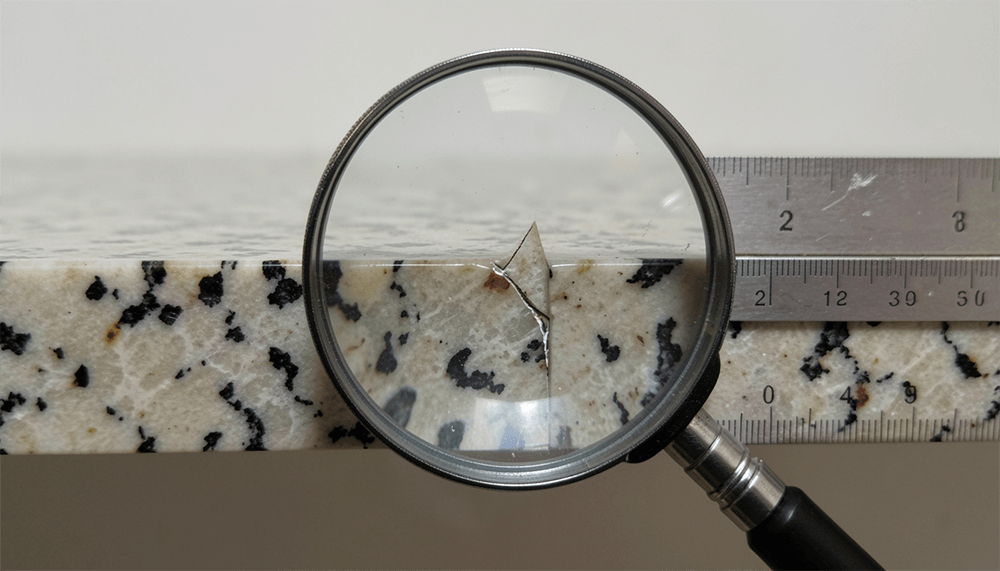
The Default Answer Is Usually Wrong
A chip appears on a benchtop and the first instinct — often reinforced by a stonemason or kitchen renovator — is that the whole thing needs replacing. Sometimes that’s true. More often it isn’t, and the difference comes down to where the damage stops.
Benchtop repair works when the damage is confined to the surface layer or edge. It becomes impractical when the substrate is compromised, the damage is too extensive for localised repair, or the structural integrity of the piece is affected. These are assessable criteria, and you can work through most of them yourself before calling anyone.
The assessment differs by material, so it helps to know what you’re working with.
Laminate Benchtops
Laminate is a printed decorative layer bonded to a particleboard or MDF substrate. Most damage happens in two ways: impact chips that break away the decorative layer, and edge swelling where water has penetrated around the sink or dishwasher.
Signs the damage is repairable: The chip or crack is limited to the decorative surface layer. When you look at the exposed area, the substrate beneath is dry, firm, and intact — it doesn’t crumble, flex, or show signs of moisture damage. The damaged area is localised rather than running along a length of edge.
Signs replacement may be necessary: The substrate is swollen, soft, or crumbling. This typically happens at edges near water sources and looks like the laminate is bubbling or lifting over a wider area than just the chip itself. Once particleboard has absorbed moisture and swelled, it won’t return to its original dimensions — filling over it produces a repair that will keep moving.
The other replacement indicator for laminate is pattern complexity. Most laminates have a printed texture — stone effect, timber grain, concrete look — and repairing the chip invisibly requires hand-painting that pattern over the filled area. This is achievable for most standard patterns. Very fine, high-resolution patterns on premium laminates are harder to replicate accurately.
The practical test: Press firmly around the edge of the damaged area. If it flexes noticeably or feels soft, moisture has likely reached the substrate. If it’s firm, the damage is probably surface-only.
Engineered Stone and Natural Stone Benchtops
Stone benchtops — Caesarstone, Silestone, Smartstone, marble, granite — chip most commonly at edges and corners, and around sink cutouts where the stone is cantilevered and unsupported. A dropped pot or appliance catching the edge is usually enough.
Signs the damage is repairable: The chip is at the edge or surface and the break is clean. The surrounding stone is intact — no cracks running from the chip toward the centre of the slab, no fracture lines visible when you look at the underside of the edge. The missing section is localised rather than a long break along the edge profile.
Signs replacement may be necessary: A crack running from the chip across the slab surface or toward a cutout. This is a structural issue, not a surface one, and a filled crack in an actively stressed area will keep moving. The same applies to a chip that has extended into a crack running toward the sink — that area is under load every time something heavy sits on the benchtop.
For natural stone specifically: deep chips that expose the interior stone can sometimes be repaired but the colour match is harder to achieve because natural stone has variation through the full depth, not just at the surface. Engineered stone is more consistent through its depth, which makes colour matching more predictable.
The practical test: Run your finger along any crack extending from the chip. If you can feel depth and the crack has clean edges, it’s older and may be stable. If the crack has sharp edges and debris, it’s recent and the stone may still be moving. Shine a torch at a low angle across the surface — stress cracks that aren’t visible straight-on often show up clearly under raking light.
Timber and Butcher Block Benchtops
Solid timber benchtops chip and dent differently from stone and laminate — the wood compresses rather than fractures cleanly, which changes the repair options.
Signs the damage is repairable: A localised chip or dent where the surrounding timber is sound. Surface-level damage — chips to the finish layer, shallow dents, knife cuts — is generally repairable with filling and localised refinishing. Heat marks and water rings that haven’t penetrated beyond the finish layer can often be cleared without touching the timber itself.
Signs replacement may be necessary: Deep water damage where the timber has darkened significantly and feels soft. Once the wood fibres have broken down from prolonged moisture exposure, the area won’t hold a finish properly. A repair over degraded timber looks fine initially and then starts to move as the timber continues to dry and shift.
Structural splits running with the grain are also a replacement indicator — these typically open and close with seasonal humidity changes and a filled split will just reopen.
The practical test: For water damage: press the discoloured area with a fingernail. Sound timber is hard; water-damaged timber that has started to break down has some give. For heat marks: look at the surface at a low angle. A heat mark that’s only in the finish layer will look milky or cloudy but the wood surface beneath will be flat. A heat mark that has charred the timber itself will show as a slight depression or texture change.
When to Get a Professional Assessment
The tests above will tell you whether the damage is obviously surface-level or obviously structural. The middle cases — a chip with a small crack extending from it, edge swelling that might be superficial, a timber dent near a water source — are harder to read without knowing what normal looks like.
A professional assessment takes about fifteen minutes on-site and will give you a clear answer: repairable, repairable with caveats, or genuinely needs replacement. The assessment is worth doing before deciding on replacement, because the cost difference is significant and the cases where replacement is genuinely necessary are narrower than most people assume.
If you have a chipped, cracked, or damaged benchtop in Sydney, Perfection Repair’s benchtop repair service covers laminate, stone, and timber across Greater Sydney. Free on-site assessment, fixed price before any work starts.