
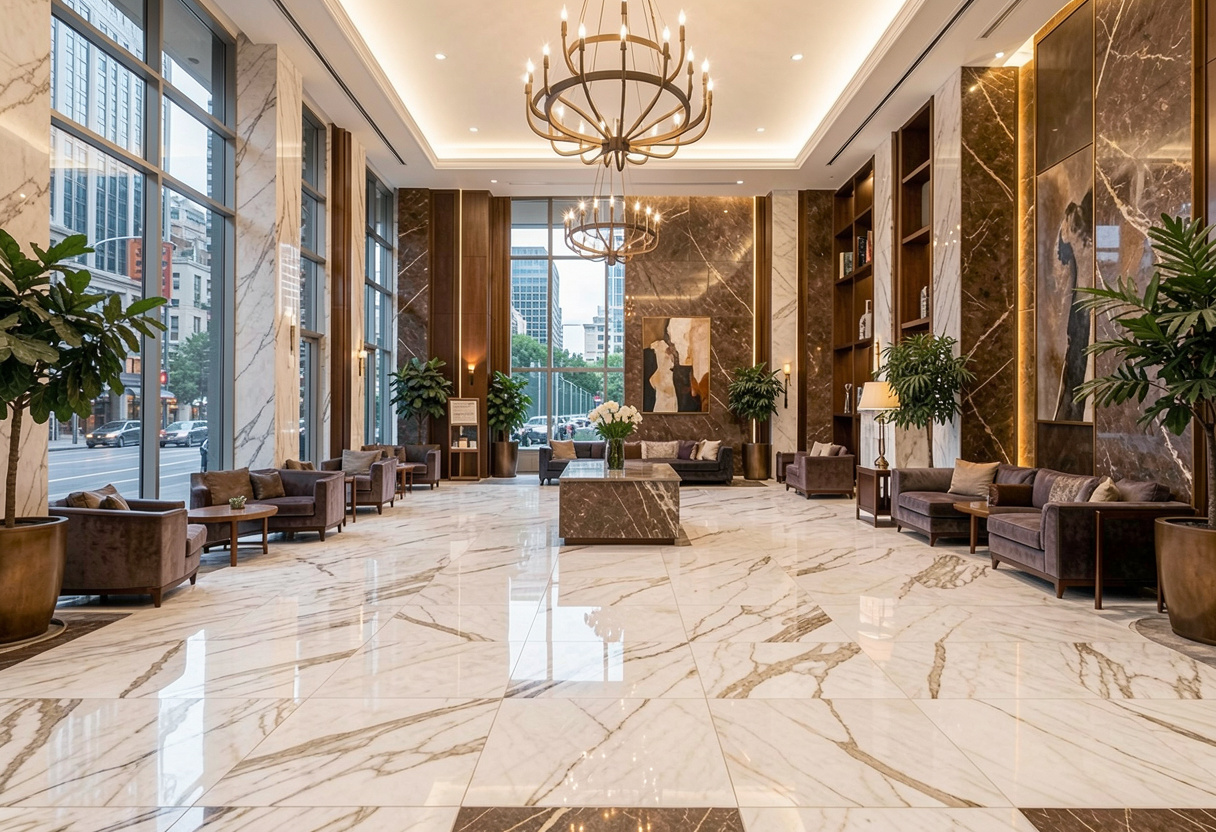
We have been commissioned to carry out the surface restoration of a Sydney CBD five-star hotel lobby — a project covering approximately 2,000 square metres of Calacatta marble flooring and wall panels, along with heritage bronze entrance doors and elevator interiors throughout the building.
This post covers what the project involves technically, why restoration was chosen over replacement, and what working in a functioning hotel actually requires from a logistics standpoint.
The Marble: What Decades of Foot Traffic Does to Stone
Calacatta marble is a visually striking material — white base with grey and gold veining — and it is also one of the more demanding surfaces to maintain in a high-traffic commercial environment. Foot traffic introduces micro-abrasion that gradually dulls the polish. Acidic spills from food and beverages cause etching — dull patches where the surface has chemically reacted. Cleaning chemicals, if not pH-neutral, compound the problem over time.
After years of daily use, the lobby floor had lost most of its original reflectivity and had developed a patchy surface where etched areas sat next to sections that had been spot-treated inconsistently over the years.
The restoration process works through the damage rather than over it. We grind back to below the etch depth using a sequence of diamond-bonded abrasive pads — starting coarse enough to remove the damage and stepping progressively finer until the surface reaches the desired polish level. The final result is a consistent mirror finish across the entire area rather than the uneven appearance that results from years of patchy maintenance.
Working in an Operating Hotel: The Practical Constraints
A residential or commercial fit-out job allows for uninterrupted access. A functioning five-star hotel does not. The lobby is in use from early morning until late evening, with peak periods during breakfast service, afternoon check-in, and dinner.
The available working window is roughly 11pm to 5:30am. That is enough time to complete sections of the floor in sequence, moving the work zone each night while the completed sections remain accessible to guests during the day.
Traditional wet-grinding — which uses water as a coolant for the diamond pads — is not practical in this environment. Water on marble floors during a hotel handover window creates slip hazards and requires extended drying time. We use a dry-polishing system with HEPA-filtered dust extraction, which eliminates the water hazard and means the surface is ready for guest traffic as soon as the equipment is cleared.
The tradeoff is slower material removal per pass, which means the grinding stages take longer. The schedule accounts for this across the project timeline.
The Bronze: Oxidation and Uneven Patina
The hotel’s entrance doors and elevator interiors are architectural bronze — a copper alloy that develops a natural patina over time. Managed correctly, bronze patina is part of the material’s appeal. Left unmanaged, it oxidises unevenly, develops fingerprint etching from skin oils, and loses the depth and consistency of the original finish.
The bronze elements in this project had reached a point where the patina was visually inconsistent — darker in some areas, stripped back to bare metal in others where cleaning staff had used abrasive products. The finish no longer read as intentional.
Restoration involves stripping the degraded surface coating, treating the underlying metal to stabilise the oxidation, and applying a new patina in stages using traditional hand-burnishing techniques. The final step is a nano-coating topcoat that slows future oxidation and makes the surface easier to maintain correctly.
This is specialist work. Standard commercial painters and building maintenance contractors do not carry the materials or have the technique for architectural bronze patination. It is one of the less common services we offer, but the hotel fit-out and heritage building sector does have recurring demand for it.
Why Restoration Rather Than Replacement
Replacing 2,000 square metres of Calacatta marble in a CBD hotel would involve removing and disposing of the existing stone, sourcing matching material — which is difficult given that marble is a natural material and quarry output varies — and a construction program that would close the lobby for weeks.
The embodied carbon in the existing marble, which was quarried and installed decades ago, is already spent. Restoration preserves that investment. The hotel group’s sustainability reporting estimates the restoration approach avoids approximately 45 tonnes of CO₂ equivalent compared to full material replacement, based on the extraction, transport, and installation of new stone.
From a practical standpoint, restoration also preserves the original material, which has a character that new stone from a different quarry batch cannot exactly replicate.
What This Means for Smaller Projects
The techniques used on this project — diamond abrasive re-polishing, dry extraction systems, bronze patination — are the same techniques we apply to residential and boutique commercial work. The scale is different; the methodology is not.
If you have a marble benchtop, stone floor, or architectural metal surface that needs restoration, the approach we take to a hotel lobby applies equally to a single kitchen island. Contact us for an on-site assessment.
For related services, see our stone repair and restoration page and benchtop repair service.