

The end of a lease tends to reveal damage you stopped noticing: an iron burn beside the couch, screw holes from a wall-mounted television, a chipped floor tile or a deep mark across a timber board. The useful first step is not to hide every sign of age. It is to separate ordinary wear from damage and compare a proportionate repair with the likely scope of replacement.
NSW Fair Trading says tenants are not responsible for fair wear and tear, but they are responsible for negligent, irresponsible or intentional damage they caused or allowed. Its examples distinguish traffic marks in carpet from burns, ordinary floor scuffing from badly scratched or gouged boards, and a worn benchtop from burns or cuts. Read the current NSW Fair Trading guidance on fair wear and tear before deciding what you need to repair.
This article is practical repair guidance, not legal advice. If responsibility or a proposed deduction is disputed, use NSW Fair Trading or an independent tenancy advice service.
Start With the Entry Condition Report
Compare the current condition with the report and photographs from the beginning of the tenancy. NSW Fair Trading describes the condition report as evidence of the property’s starting condition and recommends detailed, time-stamped photographs. The official condition report guidance is a better reference than memory alone.
For each item, record:
- one photo showing the whole room or component;
- close-up photos of the damage from several angles;
- approximate dimensions;
- the material involved;
- whether the area moves, feels damp or continues to deteriorate; and
- any matching spare material available at the property.
Do not begin with filler, glue or paint until the material and depth of the damage are clear. A failed DIY attempt can enlarge the eventual repair boundary.
Carpet Burns, Tears and Pet Damage
Carpet traffic marks and furniture indentations may be fair wear; burns, bleach spots, tears and pet damage are different. The appropriate repair depends on whether the damage is confined to the pile or extends through the backing and underlay.
Small fibre loss may be suitable for re-tufting. Larger burns commonly require removal of the damaged section and a donor piece matched for colour, pile direction, density and wear. A donor cut from a wardrobe can match the dye lot, but it still needs to be aligned and bonded correctly. A rotated pile reflects light differently and makes the patch obvious.
See our carpet repair service and carpet burn repair process for the methods used on different damage types.

Wall Holes and Paint Matching
Filling a wall hole is only half the repair. The filled area must be flush, the surrounding texture needs to continue through it, and the paint must match the wall’s current colour and sheen. Even the original paint code can appear too bright after the existing wall has aged or been cleaned repeatedly.
Before repairing, check whether the mark is a small fixing hole, torn plasterboard paper, a crushed cavity edge or a larger impact opening. Larger holes need backing and reinforcement rather than a thick mass of filler. Paint should be checked after drying under daylight and raking light, not only while wet.
Our wall and ceiling repair service covers localised plasterboard rebuilding and finish matching.
Chipped and Cracked Tiles
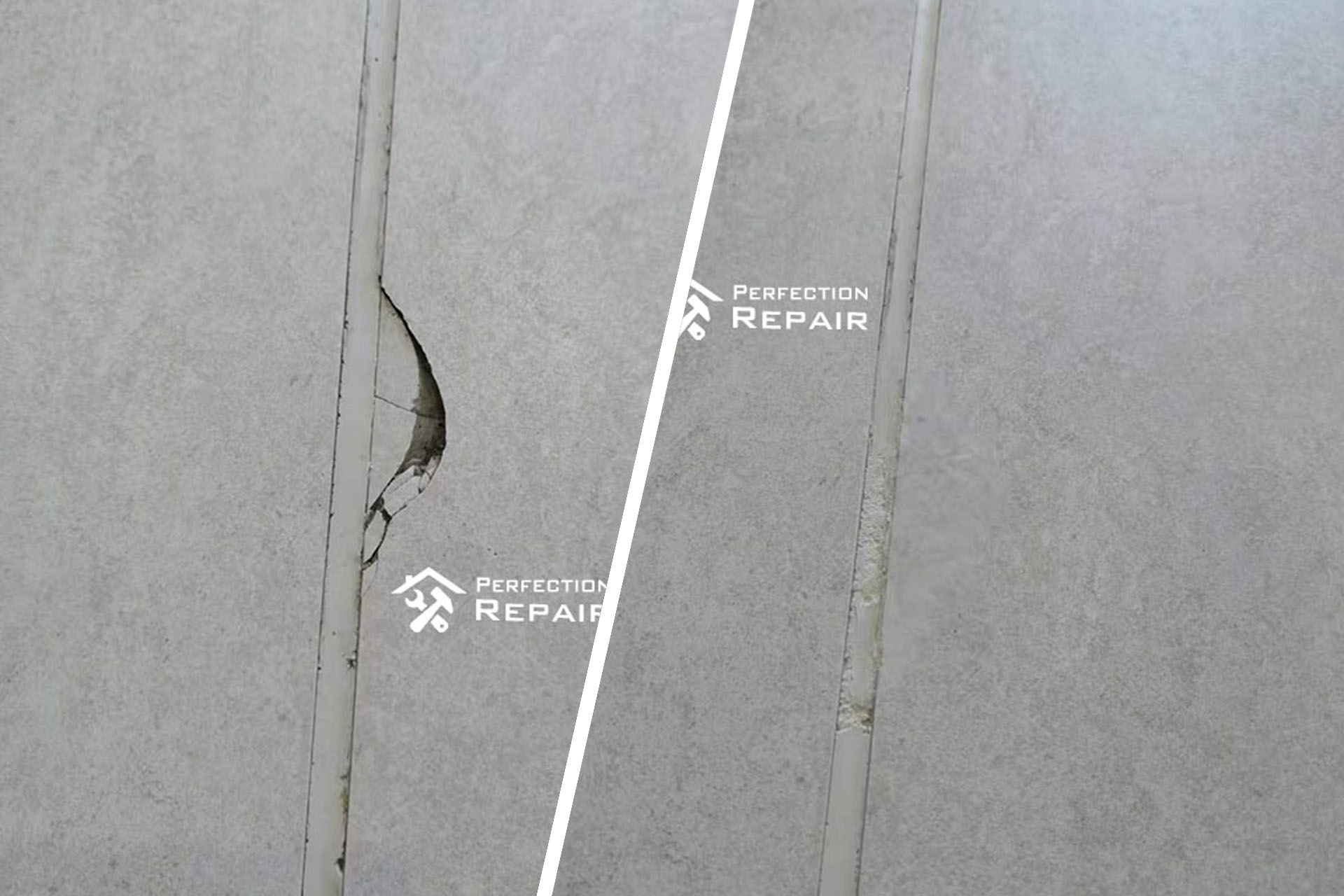
A local tile repair is viable when the substrate is stable and the surrounding grout lines are intact. If the tile moves, sounds hollow across a wide area or the crack continues into adjacent tiles, the cause may be below the surface and a cosmetic fill is unlikely to last.
For a stable impact chip, the loose material can be removed, the void rebuilt in layers, and the colour, pattern and glaze matched on site. This is especially useful when the tile batch is discontinued.
In a documented Haymarket rental project, one discontinued floor tile had a local impact fracture while the surrounding floor remained sound. The repair took three hours, replaced no tiles and disturbed no grout lines. Read the Haymarket tile repair case study or see our tile repair service.
Timber and Laminate Floor Damage
Ordinary scuffing is not the same as a deep scratch, gouge, burn or chemical coating damage. The correct response depends on whether the mark is in the protective coating, decorative layer or substrate.
A timber scratch may be rebuilt and grain-matched. A cloudy lacquer patch can sometimes be stripped and recoated locally. Swollen laminate caused by moisture generally cannot be solved by surface colouring because the board core has changed shape.
The timber floor scratch repair guide explains professional colour, grain and sheen matching. For service options, see floor repair in Sydney.
Doors, Joinery and Benchtops
Door impact holes, chipped laminate edges and small benchtop burns can sometimes be repaired without replacing the whole component. Suitability depends on the substrate. A local cosmetic chip with stable material around it is different from swelling, active moisture or a loose fitting that continues to load the damaged area.
Ask whether sinks, taps, hinges or adjacent finishes would need removal for replacement. Those secondary tasks can make a local repair more proportionate, provided the repaired area will be durable. Relevant options include door and skirting repair and benchtop repair.
When Professional Repair Makes Sense
Consider professional repair when:
- the condition report shows the damage occurred during the tenancy;
- the defect is clearly beyond normal wear;
- the substrate is stable and damage is localised;
- replacement would disturb otherwise serviceable material; and
- the repair can be completed before the final inspection.
Do not authorise a cosmetic repair when moisture, structural movement, electrical risk or another active defect is involved. Notify the landlord or agent about underlying maintenance issues rather than covering them.
Evidence to Keep Before the Final Inspection
Keep the original condition report, dated before photos, the repair quote, invoice and matching after photos. Photograph the completed repair from the same distance and angle as the original damage. Avoid relying on a single extreme close-up that does not show where the repair sits in the room.
NSW Government guidance says renters should repair damage beyond fair wear and tear before claiming their bond and explains the dispute process if the parties do not agree. Review the current bond refund steps before the tenancy ends.
Request an Assessment Before Expanding the Scope
Send us clear photos, approximate measurements, the suburb and the inspection date. We will tell you whether the damage appears suitable for localised restoration, whether an on-site assessment is needed, or whether replacement is the more responsible option. Start with our end-of-lease repair service or contact the technical team.